Combined Master's Degree Programme for Working Professionals (3 years)
| About the programme Language: English (See language requirements) | Place of study: Aarhus | Commencement: August / September (See if this programme also offers a January/February start for international applicants). Programme type: Combined Master's Degree Programme for Working Professionals (3 years) |
The Master of Science in Electrical Engineering at Aarhus University is offered both as a traditional full-time programme and as a Combined Master´s degree for working professionals, where you study while gaining professional experience in a relevant job.
In this model, you build on your undergraduate degree with one year of full-time studies at the university. After this, you continue with two years of part-time studies while working an average of 25 hours per week in a company or as an entrepreneur.
During this period, you receive a salary based on recommended entry-level salaries for engineers in Denmark instead of a student grant. This allows you to gain both financial independence and valuable professional experience while completing your master’s studies at a top-100 university.
Despite the extended duration, you graduate with the exact same degree and academic level (cand.polyt.) as students enrolled in the ordinary full-time Master’s programme.
Aarhus University offers a dedicated matchmaking service that helps connect students with companies. This ensures that you can find a workplace that aligns with your academic interests and career goals, and that your employment tasks are relevant to your studies.
The Master of Science in Electrical Engineering at Aarhus University – ranked among the world’s top 100 universities – prepares you to compete at the highest international level on the global job market. You will learn to combine deep theoretical insight, cutting-edge research and practical skills preparing you to take on leadership roles in technology-driven industries.
Building on the foundation of your undergraduate degree, you will gain specialised knowledge in areas such as electronics, communication systems, renewable energy, chip design, photonics, signal processing, and artificial intelligence. You will work analytically with complex problems, and learn to turn theory into impact.
From your very first semester, you will engage with real-world problems in close collaboration with business partners. You will be trained to think creatively, to see opportunities where others see limitations, and to develop solutions for challenges that do not yet have a clear answer.
How can we design energy systems that are both stable and sustainable? Can nanotechnology be applied to create ultra-small sensors capable of detecting pollution in the air or early signs of disease in the human body? And what technological advances will enable the development of next-generation high-speed internet, where everything from phones and wearables to cars, cities, and factories communicate and exchange data in real time?
These are examples of the complex and forward-looking challenges you may engage with as a student.
As a graduate, you will not only master advanced engineering methods but also develop the adaptability, curiosity, and leadership skills needed to drive technological progress in a rapidly changing world.
The programme offers a high level of flexibility. While you will take some mandatory courses, you will also have the freedom to shape your academic path through electives. You can choose from eleven carefully designed specialisations – all of them fine-tuned to reflect the latest technological developments and created in close collaboration with industry.
This ensures that your education is not only academically strong, but also aligned with the skills and expertise most in demand in the global economy.
You can choose between 11 different specialisations, each allowing you to shape your degree according to your specifik job challenges, interests and career goals. (Click on the links below to read more about each specialisation.)
You can choose from the following specialisations:
In this section you can learn more about the admission requirements relevant to the 1+2 work-integrated Master's degree programme in Electrical Engineering. Depending on your educational background and your qualifications, there are different ways to meet the admission requirements:
This section is relevant for you, if you have:
The two sections listed below are relevant only for students with a bachelor's degree from a Danish institution:
Below these sections, you can learn more about the employment requirement and the English language requirement. You can also find out which ranking criteria we use to assess your application when prioritizing among the submitted applications.
If you have an international educational background, you must meet both the general admission requirement and the specific admission requirements:
You must have a bachelor's degree or equivalent that is comparable to a Danish bachelor's degree in both level and duration (180 ECTS).
For more information about how your bachelor's degree is assessed, please see the national database.
If you meet the general admission requirement, the university will continue on to assess whether or not you meet the specific admission requirements.
You can be admitted to the master's programme if the university assesses that your education has a level, scope, and content that corresponds to the academic requirements specified below.
| You can meet the admission requirement with a Bachelor’s degree programme (BSc) or professional Bachelor's degree programme (BEng) if you have the following subject areas: | Number of ECTS |
Mathematics In the following subject areas:
| 20 |
| Bachelor courses in Physics within the topics; classical physics, electrostatics and dynamics, classical optics and basic quantum mechanics | 5 |
| Bachelor courses in Electrical Engineering within the topics: digital and analogue electronics. | 30 |
Additionally, bachelor courses in within at least one of the following topics:
| 10 |
| Total | 65 |
We cannot assess in advance whether your specific degree will meet the above requirements. Therefore, we recommend that you apply for the programme if you believe that you meet the academic requirements. In this regard, it is a good idea to compare your degree with the programmes that provide direct admission.
No Bachelor's degree programme(s) from Aarhus University entitles applicants to an offer of admission to the 1+2 work-integrated Master's degree programme in Electrical Engineering.
Certain Bachelor's degree programmes from Aarhus University and various other Danish Universities have been determined to meet the admission requirements to this work-integrated Master's degree programme in Electrical Engineering:
You must fill in this appendix and upload it to the application portal. The appendix helps the Admission Board to assess your application.
Download appendix
In order to be admitted to this programme you must meet the university's English language requirements.
Students with bachelor's degree from Aarhus University with a so-called 'Legal right of admission' are exempt from the English language requirement.
All Master’s degree programmes at Aarhus University have limited intake. This means that you are not guaranteed admission even if you meet the entry requirements. When we prioritize among applicants, we assess your application based on a set of fixed ranking criteria, which you can see below.
If you have a legal right of admission, you are guaranteed a place in the programme and do not need to consider the ranking criteria.
Ranking criteria:
Please note that grades achieved after the application deadline are not included in the assessment.
Unfortunately, Aarhus University is not able to assess your qualifications beforehand. In order for your qualifications to be assessed you must apply for admission. To learn more, please go to Assessment of your qualifications.
The Master of Science in Computer Engineering is a 3-year programme consisting of 6 semesters.
You can choose between 11 different specialisations, each allowing you to shape your degree according to your specifik job challenges, interests and career goals. (Click on the links below to read more about each specialisation.)
You can choose from the following specialisations:
In the specialisation, you combine Level I (fundamental) and Level II (advanced), courses to earn at least 15 ECTS at Level II.
When you choose electives, you can choose from a wide range of courses from Aarhus University.
The Academic regulations will be available soon.
If you choose the work-integrated Master’s degree in Electrical Engineering, your student life will extend over four years. Throughout the entire programme, you combine part-time studies with part-time work in a company or as an entrepreneur, typically around 25 hours per week.
This means that instead of separating theory and practice, you continuously bring academic knowledge into your workplace while also drawing on real-life challenges in your studies.
Alongside your professional life, you remain an active part of the student community. Your courses are structured with flexibility in mind. n this way, you gain colleagues and a professional network, while still experiencing the social life at university.
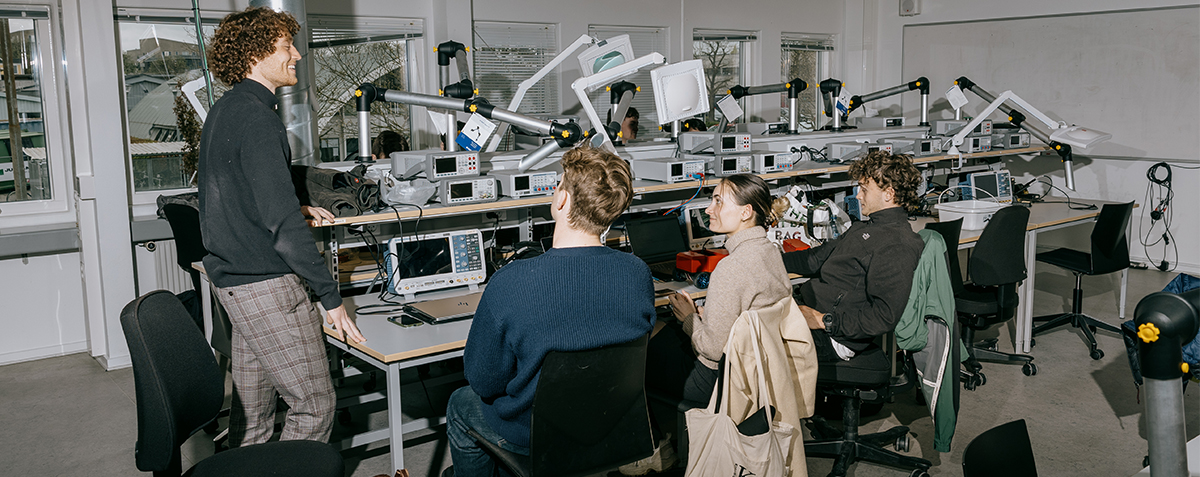
Daily life on campus is shaped by a dynamic mix of lectures, small-group classes, and project-based learning. You will take a scientific and experimental approach, working hands-on with prototypes, testing ideas, and developing solutions in practice. Much of the teaching is research-based, and you will be taught by active researchers who bring the newest knowledge into the classroom. You will also have the opportunity to participate in research projects yourself and experience how science is created.
You will be based at Katrinebjerg – the “IT city” of Aarhus – located close to the unique main campus of Aarhus University and the city center. Here, you will find a wide range of student accommodation and a rich cultural life, offering everything from running clubs and the annual regatta on the lake to guest lectures and film screenings. To ensure student well-being, counselling services and support networks are always available.
-experienced, photographed and filmed by the students themselves.
With thousands of pictures #AUInternational, #AarhusUni gives insight into the everyday life as a student at AU; the parties, procrastination, exams and all the other ways you’ll spend your time at university.
The photos belong to the users, shared with #AUInternational and #AarhusUni.
As a graduate of the MSc in Electrical Engineering, you will enter a job market with excellent opportunities – in Denmark as well as internationally. Unemployment among engineers in this field is very low, and starting salaries are among the highest for graduates in Denmark.
Your expertise in electronics, combined with your ability to analyse complex problems, generate new knowledge, and approach technology with a holistic mindset, makes you highly sought after across sectors. Employers look for engineers who not only master technologies, but who can also drive innovation, reflect critically, and take responsibility for how technology is applied in society.
You might work as a data specialist, development engineer, systems architect, hardware developer, project manager, research engineer, innovation manager, technical specialist, or even as a Chief Technology Officer (CTO) with responsibility for technological strategy. Your skills are relevant in a wide range of industries – from energy, healthcare, IT, and defence to agriculture and manufacturing.
The degree also provides an excellent foundation for pursuing a research career through a PhD programme, allowing you to dive even deeper into your field and contribute to groundbreaking developments.
You can read more about the PhD programme at the Graduate School of Technical Sciences.