Master's Degree Programme for Working Professionals (4 years)
| About the programme Language: English (See language requirements) | Place of study: Aarhus | Commencement: August / September (See if this programme also offers a January/February start for international applicants). Programme type: Master's Degree Programme for Working Professionals (4 years) |
The Master of Science in Biotechnology and Chemical Engineering at Aarhus University is offered both as a traditional full-time programme and as a work-integrated Master’s degree, where you study while gaining professional experience in a relevant job.
In this model, the programme takes four years to complete, as you work 25 hours per week on average a year alongside your studies. This is a truly unique opportunity in an international context, since only few universities worldwide allow you to integrate paid employment with a full master’s degree.
Instead of applying for a student grant, you receive a salary typically based on the recommended entry-level rates for engineers in Denmark.
This will give you both financial independence and valuable industry experience, while enabling you to apply your academic knowledge directly in the workplace.
Despite the extended duration, you graduate with the exact same degree and academic level (cand.polyt.) as students enrolled in the ordinary full-time Master’s programme.
Aarhus University offers a dedicated matchmaking service that helps connect students with companies. This ensures that you can find a workplace that aligns with your academic interests and career goals, and that your employment tasks are relevant to your studies.
Biological and chemical processes play a vital role in everything from food production and medicine to green energy and environmental technologies. In the Master’s programme in Biotechnology and Chemical Engineering, you will learn to understand and work with these processes.
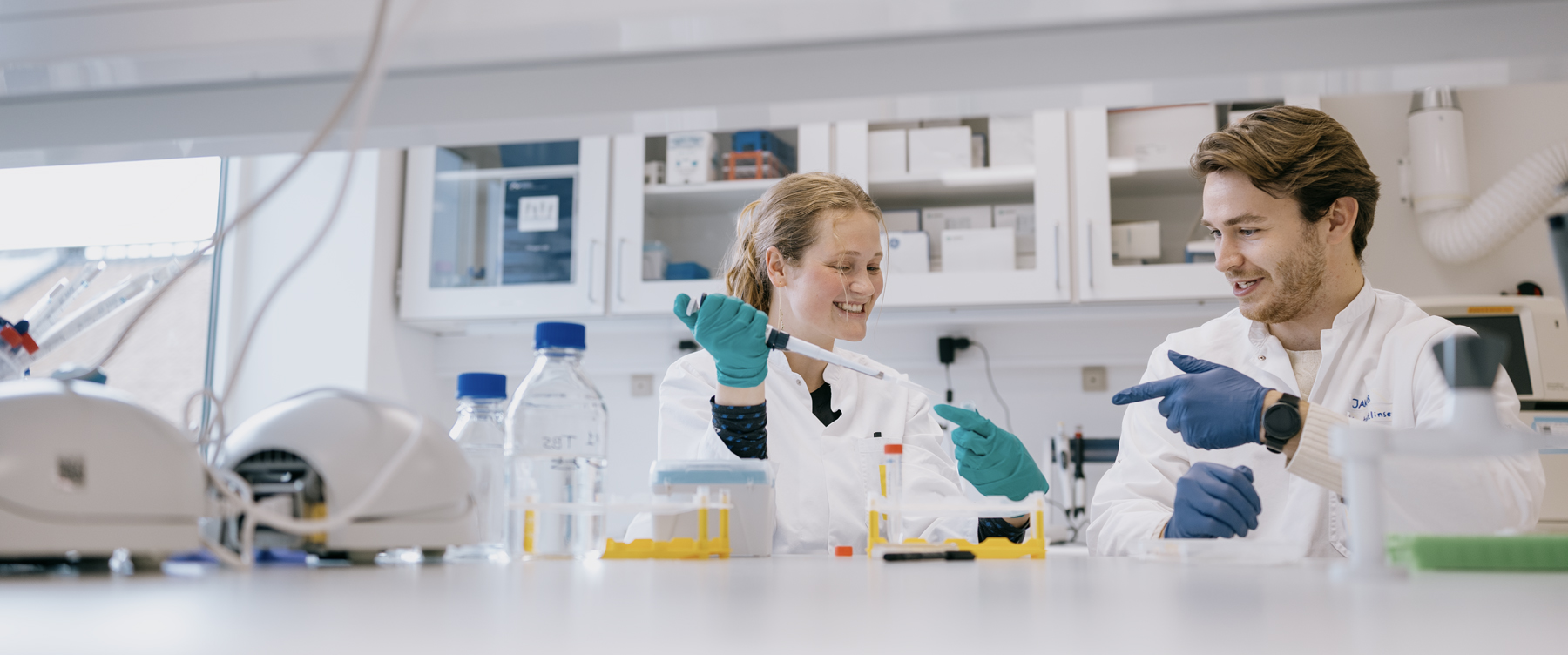
Building on your background in chemical or biological engineering, you will deepen your theoretical knowledge and gain practical experience with systems that range from microscopic cell cultures to large-scale industrial processes. From your very first semester, you will be working in labs and pilot facilities, using your scientific insight to solve real-world problems and explore creative solutions to problems we don’t yet have answers to.
Throughout the programme, you will learn to work creatively and analytically with chemical and biological systems – and to collaborate across disciplines to find new solutions to some of society’s challenges. You will be trained to combine research-based knowledge with practical application, preparing you to lead innovation projects in both industry and academia.
The programme offers a high degree of flexibility, allowing you to tailor your academic focus. While you will take some mandatory courses, you will largely shape your own academic journey through electives and specialisations ranging from Industrial Biotechnology, Medical Technology, and Plastic Materials to Biorefining, Energy and Storage, and Water Technology.
You can choose between You can choose between 12 different specialisations, each allowing you to shape your degree according to your specific job challenges, interests and career goals.
Read more about the study packages under "Programme Structure"
In this section you can learn more about the admission requirements relevant to the flexible work-integrated Master's degree programme in Biotechnology and Chemical Engineering. Depending on your educational background and your qualifications, there are different ways to meet the admission requirements:
This section is relevant for you, if you have:
The two sections listed below are relevant only for students with a bachelor's degree from a Danish institution:
Below these sections, you can learn more about the employment requirement and the English language requirement. You can also find out which ranking criteria we use to assess your application when prioritizing among the submitted applications.
If you have an international educational background, you must meet both the general admission requirement and the specific admission requirements:
You must have a bachelor's degree or equivalent that is comparable to a Danish bachelor's degree in both level and duration (180 ECTS).
For more information about how your bachelor's degree is assessed, please see the national database.
If you meet the general admission requirement, the university will continue on to assess whether or not you meet the specific admission requirements.
You can be admitted to the master's programme if the university assesses that your education has a level, scope, and content that corresponds to the academic requirements specified below.
| You can meet the admission requirement with Bachelor’s degree programme (BSc) or professional Bachelor's degree programme (BEng) if you have the following subject areas: | Number of ECTS |
OR:
| 60 |
Mathematics In the following subject areas:
| 20 |
| Total | 80 |
We cannot assess in advance whether your specific degree will meet the above requirements. Therefore, we recommend that you apply for the programme if you believe that you meet the academic requirements. In this regard, it is a good idea to compare your degree with the programmes that provide direct admission.
No Bachelor's degree programme(s) from Aarhus University entitles applicants to an offer of admission to the flexible work-integrated Master's degree programme in Biotechnology and Chemical Engineering.
Certain Bachelor's degree programmes from Aarhus University and various other Danish Universities have been determined to meet the admission requirements to this work-integrated Master's degree programme in Biotechnology and Chemical Engineering:
When applying for a work-integrated Master’s degree programme, you must meet the requirement of being in relevant employment.
“Relevant employment” means that you work at least 25 hours per week in a public or private company, or as an entrepreneur, and that your work tasks are professionally related to both your qualifying education and the education you are applying for.
In order to be admitted to this programme you must meet the university's English language requirements.
Students with bachelor's degree from Aarhus University with a so-called 'Legal right of admission' are exempt from the English language requirement.
All Master’s degree programmes at Aarhus University have limited intake. This means that you are not guaranteed admission even if you meet the entry requirements. When we prioritize among applicants, we assess your application based on a set of fixed ranking criteria, which you can see below.
If you have a legal right of admission, you are guaranteed a place in the programme and do not need to consider the ranking criteria.
Ranking criteria:
Please note that grades achieved after the application deadline are not included in the assessment.
Unfortunately, Aarhus University is not able to assess your qualifications beforehand. In order for your qualifications to be assessed you must apply for admission. To learn more, please go to Assessment of your qualifications.
The programme is divided into 30 ECTS credits per year and lasts 4 years.
You specialise by participating in course activities and projects and by writing a thesis. You structure your own individual study programme with the help of a researcher by choosing courses from the course catalogue.
Your programme is based on your academic qualifications and interests and the subjects you studied for your Bachelor’s degree. The plan must be approved by the Board of Studies before you can enrol for examinations.
Sensors and Process Control - 10 ECTS
Transport Phenomena - 5 ECTS
Modern Chemical Process Technologies - 10 ECTS
Lipid Biotechnology - 5 ECTS
Protein and Carbohydrate Biotechnology - 10 ECTS
Microbial Biotechnology - 5 ECTS
Industrial Bioseparation Technology - 5 ECTS
Applied Lipid and Protein Biotechnology
Applied Lipid Biotechnology - 5 ECTS
Applied Protein Biotechnology - 10 ECTS
Biomacromolecules
Lipid Biotechnology - 5 ECTS
Protein and Carbohydrate Biotechnology - 10 ECTS
Biomaterial Engineering
Tissue Engineering - 5 ECTS
Biofabrication - 10 ECTS
Energy and Storage
Energy Conversion and Storage Technologies - 10 ECTS
Renewable Energy Technologies 5 ECT
Environmental Technology
Air Treatment Technologies - 5 ECTS
Water Treatment Technologies - 10 ECTS
Process Technology
Sensors and Process Control -10 ECTS
Transport Phenomena - 5 ECTS
Plastic Materials
Advanced Polymer and Nanomaterials - 10 ECTS
Plastic Engineering - 5 ECTS
Biorefining Technology
Experimental Biorefining - 5 ECTS
Integrated Biorefining Technologies - 10 ECTS
Chemical Processing
Platform molecules – Production and Processes - 10 ECTS
Catalysis and Materials Engineering - 5 ECTS
Medical Biotechnology
Immunological Biotechnology - 10 ECTS
Biomolecular Interactions - 5 ECTS
Industrial Biotechnology
Microbial Cell Factories - 5 ECTS
Biocatalyses and Enzymatic Processes - 10 ECTS
Computational Systems Biology
Systems Biochemistry 10 ECTS
Applied Systems Biochemistry 5 ECTS
For further information on the structure of the programme please see the academic regulations for master's degree programmes.
If you have the necessary skills and interest, you have the option of applying for admission to the PhD programme. In the PhD programme, you start working on a research project and are gradually trained through courses and personal guidance to become a researcher.
If you choose the work-integrated Master’s degree in Biotechnology and Chemical Engineering, your student life will extend over four years. Throughout the entire programme, you combine part-time studies with part-time work in a company or as an entrepreneur 25 hours per week. This means that instead of separating theory and practice, you continuously bring academic knowledge into your workplace while also drawing on real-life challenges in your studies.
Alongside your professional life, you remain an active part of the student community. Your courses are structured with flexibility in mind. This way, you gain colleagues and a professional network, while still experiencing the social life at university.
Your daily life will be shaped by a dynamic mix of lectures, small-group classes, lab work, and project-based learning. You will take a scientific and experimental approach, working in laboratories and pilot facilities to test ideas and develop real-world solutions. Much of the teaching is research-based, and you will be taught by active researchers who bring the latest developments into the classroom. You will also have the opportunity to take part in research projects yourself and gain insight into how new scientific knowledge is created and applied.
The student life unfolds in and around the University Park and University City campus areas in downtown Aarhus. You’ll be part of an open and engaged study environment with access to laboratories, group workspaces and café areas. There are plenty of opportunities to join academic events, social activities and student associations and the city of Aarhus boasts excellent student accommodation and a rich cultural life. To ensure student well-being, counselling services and support networks are always available.
-experienced, photographed and filmed by the students themselves.
With thousands of pictures #AUInternational, #AarhusUni gives insight into the everyday life as a student at AU; the parties, procrastination, exams and all the other ways you’ll spend your time at university.
The photos belong to the users, shared with #AUInternational and #AarhusUni.
Graduates of the MSc in Biotechnology and Chemical Engineering enter a job market with excellent opportunities and very low unemployment. Importantly, the programme prepares you not only for careers in Denmark but also internationally. Your expertise in chemical and biological processes, combined with your ability to understand complex systems, generate new knowledge, and think creatively and holistically, makes you a highly attractive candidate across great many sectors.
If you choose the work-integrated Master’s degree, your employment during the programme often leads directly to a full-time position in the same company once you graduate. This gives you a unique opportunity to build a career while you study, establish strong professional networks, and step seamlessly into the job market.
You can work in industries such as food, energy, pharmaceuticals, or biotechnology, where you help design, improve, and scale up production processes. You might join green innovation projects, using biotechnology or modern chemical processes to reduce society’s dependence on fossil resources. Or you could be involved in developing new materials – such as oil-free plastics or chemical/electrochemical catalysts – and processes that support the transition to a more sustainable future. You may also work with environmental technologies, creating solutions that help clean wastewater, reduce air pollution, or lower the environmental impact of industrial production.
The degree also provides an excellent foundation for pursuing a research career through a PhD programme, allowing you to dive even deeper into your field and contribute to groundbreaking developments.
You can read more about the PhD programme at the Graduate School of Technical Sciences.