Full-time Master’s Degree Programme (2 years)
| About the programme Language: English (See language requirements) | Place of study: Aarhus | Commencement: August / September (See if this programme also offers a January/February start for international applicants) | Programme type: Full-time Master’s Degree Programme (2 years) |
The Master’s programme in Computer Science at Aarhus University builds on the fundamental competencies acquired during a bachelor’s degree in computer science or a related field. The programme is a two-year, full-time degree structured across four semesters. During the first three semesters, you will choose elective courses that allow you to specialise in areas aligned with your academic interests and career goals. The final semester is dedicated to your master’s thesis, which may be written in collaboration with a company or as part of a research project.
The programme is taught entirely in English and brings together students from Denmark and around the world. Throughout your studies, academic advisors support you in designing a coherent and personalised study plan.
The programme offers four main specialisations:
Choosing a specialisation is optional. You may also design your own profile by combining courses across different specialisations.
At Aarhus University, you will receive a world-class education at a highly ranked European research university. The Department of Computer Science is among the global leaders in cryptography and programming languages and is internationally recognised for its research in areas such as artificial intelligence, algorithms, human-computer interaction (HCI), and cybersecurity. This strong research foundation attracts top researchers and students from across the globe, ensuring an intellectually stimulating and truly international learning environment.
In this section you can learn more about the admission requirements relevant to the master's degree programme in Computer Science. Depending on your educational background and your qualifications, there are different ways to meet the admission requirements:
This section is relevant for you, if you have:
The two sections listed below are relevant only for students with a bachelor's degree from a Danish institution:
Below these sections, you can learn more about the English language requirement. You can also find out which ranking criteria we use to assess your application when prioritizing among the submitted applications.
If you have an international educational background, you must meet both the general admission requirement and the specific admission requirements:
You must have a bachelor's degree or equivalent that is comparable to a Danish bachelor's degree in both level and duration (180 ECTS).
For more information about how your bachelor's degree is assessed, please see the national database.
If you meet the general admission requirement, the university will continue on to assess whether or not you meet the specific admission requirements.
You can be admitted to the master's programme if the university assesses that your education has a level, scope, and content that corresponds to the academic requirements specified below.
| Subject area | Number of ECTS |
Programming You must have a minimum of 20 ECTS credits in programming. The following subject areas are typically considered, but other relevant courses within programming may also be included:
| 20 |
Computer Systems You must have a minimum of 20 ECTS credits in computer systems. The following subject areas are typically considered, but other relevant courses within computer systems may also be included:
| 20 |
Theoretical Computer Science and/or Human-Computer Interaction You must have a minimum of 20 ECTS credits in Theoretical Computer Science and/or Human-Computer interaction. The following subject areas are typically considered, but other relevant courses within Theoretical Computer Science may also be included:
| 20 |
Basic subjects in Mathematics, Probability Theory and Statistics You must have a minimum of 20 ECTS credits in foundational mathematical subjects, like calculus/analysis, (linear) algebra, discrete math/graph theory, or probability theory and statistics. | 20 |
| Total | 80 |
We cannot assess in advance whether your specific degree will meet the above requirements. Therefore, we recommend that you apply for the programme if you believe that you meet the academic requirements. In this regard, it is a good idea to compare your degree with the programmes that provide direct admission.
The following Bachelor's degree programme(s) from Aarhus University entitles you to an offer of admission to the Master's degree programme in Computer Science.
Please note that you must apply for admission to the Master's degree programme within three years of completing your Bachelor's degree programme.
Learn more about Legal right of admission.
Certain Bachelor's degree programmes from Aarhus University and various other Danish Universities have been determined to meet the admission requirements to this Master's degree programme in Computer Science:
If you obtained your Bachelor's degree from an educational institution outside Denmark, we ask you to complete an appendix to help us assess whether you meet the programme's academic admission requirements. In the appendix, please specify which courses you have completed as part of your Bachelor's degree within the required subject areas.
You will find a link to the appendix in the confirmation message you receive in the application portal (DANS) after submitting your application.
All Master’s degree programmes at Aarhus University have limited intake. This means that you are not guaranteed admission even if you meet the entry requirements. When we prioritize among applicants, we assess your application based on a set of fixed ranking criteria, which you can see below.
If you have a legal right of admission, you are guaranteed a place in the programme and do not need to consider the ranking criteria.
Ranking criteria:
In criterion three, the score is based on the proportion of subjects on the bachelor’s degree diploma that fall within the relevant subject fields. In this assessment, ECTS credits that are a part of the admission requirements described under ‘Other qualifying degrees’ are not included.
Please note that grades achieved after the application deadline are not included in the assessment.
In order to be admitted to this programme you must meet the university's English language requirements.
Students with bachelor's degree from Aarhus University with a so-called 'Legal right of admission' are exempt from the English language requirement.
Unfortunately, Aarhus University is not able to assess your qualifications beforehand. In order for your qualifications to be assessed you must apply for admission. To learn more, please go to Assessment of your qualifications.
The master’s degree in computer science is a two-year programme divided into four semesters. During the first three semesters, you will take elective courses that allow you to specialise in areas that match your interests and career goals. The fourth semester is dedicated to your master’s thesis, which you may choose to write in collaboration with a company.
You don’t need to decide everything upfront. Once enrolled, our education advisors will guide you in planning your study path to suit your interests and ambitions.
We offer four master specialisations:
Choosing a specialisation is not required. You are also free to create your own academic focus by combining courses across our different course packages. Learn more about the programme structure and available courses here.
The teaching style is a mix of lectures and classes all taught in English, with preparatory work in study groups. If you have questions or need help with an assignment, you can meet with the professor or the teaching assistants assigned to the course. The workload is estimated at 45 hours per week – including classes, assignments, and group work. Still, most of our students find time for a student job. For more info on student jobs, check the career section below.
Starting from 2027, it is planned that this programme will be offered as both a 1-year and a 2-year Master's degree programme.
If you have a legal right of admission to this programme because you have a specific bachelor's degree from Aarhus University, we expect that your right of admission will apply to the 1-year programme.
When we know more about the new structure, we will provide updates on this page.
The Department of Computer Science has many spaces for getting together with fellow students outside class, which form an excellent basis for both study-related and social activities. The department and our student associations organize a variety of events and tech talks in collaboration with local and international companies. There is also a popular Friday bar, and students organize the annual hackathon AUHack.
The Department of Computer Science is in the IT City Katrinebjerg, where Aarhus University has consolidated all its IT programmes and research. As the largest IT education center in Denmark, with more than 3,000 students and 200 researchers, IT City Katrinebjerg is an exciting study environment. This multidisciplinary hub, unique to Aarhus University, provides great opportunities in IT for students, researchers, and businesses to work and interact together.
The IT city Katrinebjerg is close to the unique main campus of Aarhus University. The campus is located near the city center, and student accommodation is readily available as long as you apply on time. There are a range of activities, ranging from running to regatta on the lake, as well as guest lectures, film screenings, and university events taking place throughout the year. To ensure student well-being, counselling services are available for students, to offer support and guidance during their time at Aarhus.
Want to know more about student life in Aarhus? Ask all your questions about courses, workload, student jobs and much more via Unibuddy. Our friendly student ambassadors are here to answer your questions. Find an ambassador from your home country or the subject you want to study.
As the second-largest city in Denmark, Aarhus is a young and dynamic place with plenty of opportunities. The 40,000 students at the university make up almost 20% of the city’s population, which leaves its mark on city life. An attractive feature of Aarhus is that beaches and woods are just a short bike-ride away, as well as many cultural events taking place throughout the year, including the Aarhus Festival in September. The theatres in the city and the ARoS art museum offer many events that enable you to experience the Danish culture.
- experienced, photographed and filmed by the students themselves.
With thousands of pictures #yourniversity gives insight into the everyday life as a student at AU; the parties, procrastination, exams and all the other ways you’ll spend your time at university.
The photos belong to the users, shared with #Yourniversity, #AarhusUni and course-specific AU-hashtags.
Or follow the everyday life at the Department of Computer Science:

The chart shows the five most common types of work for graduates 1-2 years after finishing their degree. The data is derived from a survey made by Epinion for the Ministry of Higher Education and Science and Aarhus University in 2020.
Computer scientists continue to be in great demand all over the world, and this is also the case in Denmark. Computer science graduates from Aarhus University have an excellent reputation and are in very high demand for exciting and well-paid jobs in and around Aarhus or abroad. Recent graduates have been recruited by leading IT companies in areas such as software development, consultancy work, project management, and research.
Moreover, many Aarhus-based IT companies are on the lookout for student employees for part-time jobs. The department has a close collaboration with the industry network Tech Hub Aarhus, who helps international IT talents find student- or full-time jobs. The department also has an online ‘jobwall’, and every year we host a career fair (“Kdag”), where students get a unique opportunity to meet more than 50 IT companies.
On cs.au.dk/career you can read about some of our graduates and their exciting jobs.
If you are interested in staying in academia, the department also has a very popular PhD programme. It is possible to apply for admission during your master studies. The PhD programme is open for admission four times a year. All PhD positions at the department are fully funded.
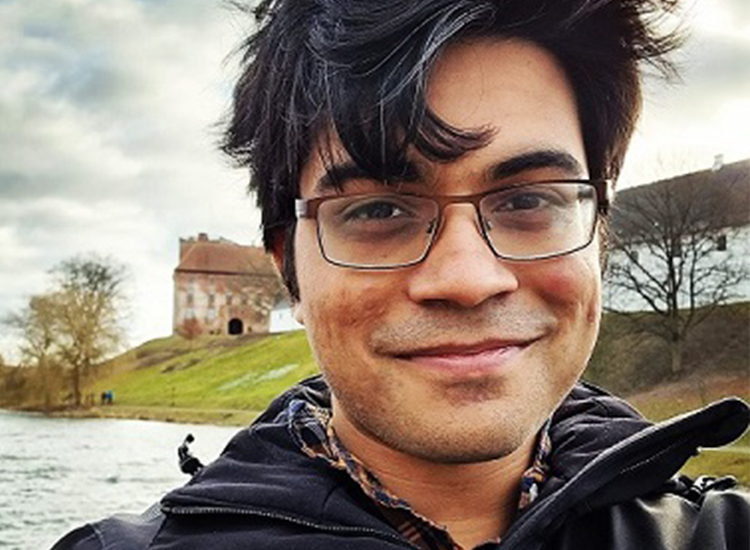
Harshit Mahapatra from India completed his master in Computer Science at Aarhus University in 2020.
He decided to stay in Aarhus and now works at the Alexandra institute. Read more about his experience.
Many of our students are interested in innovation and starting up new companies. At the Department of Computer Science, one of our goals is to support entrepreneurial activities of our students and recent graduates. Therefore, we have created an experimental innovation lab and incubator environment called HatchIt Lab.
In HatchIT Lab, you can develop a start-up idea in a business-oriented incubation and innovation environment. The lab is located close to the IT research and educational facilities at Aarhus University. Hereby, HatchIT Lab contributes to collaboration between students, researchers, and companies. As an open innovation environment, HatchIT Lab supports the sharing of knowledge and experiences between students, entrepreneurs, small and medium-sized businesses, and well-established companies.