
Master's Degree Programme for Working Professionals (4 years)
| About the programme Language: English (See language requirements) | Place of study: Aarhus | Commencement: August / September (See if this programme also offers a January/February start for international applicants). Programme type: Master's Degree Programme for Working Professionals (4 years) |
With the work-integrated master in Nanoscience, you gain an interdisciplinary science education that combines chemistry, physics and molecular biology to understand, design and control materials and systems at the nanoscale. At this length scale, materials behave differently: surfaces and quantum effects govern properties such as colour, strength, reactivity and biological interactions—properties that cannot be controlled in the same way at larger scales.
These are precisely the effects we exploit when developing smarter sensors, targeted medicines, more sustainable energy solutions and advanced materials. But nanoscale phenomena do not follow a single scientific discipline: chemical reactions, biological functions and physical properties are tightly interlinked. That is why an interdisciplinary approach is essential when working with, for example, catalysts, medicines, nanomaterials and biosensors.
The programme draws on strong research environments, and you can specialise in areas such as nanomaterials, nanocatalysis, nanobiotechnology, nanomedicine, nanofood (food nanotechnology), toxicology, or the ethical dimensions of nanotechnology.
The Master's degree programme for working professionals is designed for students who are employed while studying. You complete the programme alongside your job or entrepreneurial activities.
The programme creates a strong link between theory and practice, as you are able to apply your academic learning directly to relevant work tasks. You bring the latest academic knowledge into your workplace, while at the same time gaining valuable experience in applying this knowledge in practice.
The programme has a standard duration of four years.
The specific requirements regarding the number of working hours needed for admission to the scheme are outlined under ‘Admission requirements’.
You will build application-oriented competences in advanced experimental work and data analysis across disciplines - skills that translate directly into sectors such as biotechnology and pharmaceuticals, energy and materials, and the food and environmental sectors.
In this section you can learn more about the admission requirements relevant to the work-integrated Master's degree programme in Nanoscience. Depending on your educational background and your qualifications, there are different ways to meet the admission requirements:
This section is relevant for you, if you have:
The two sections listed below are relevant only for students with a bachelor's degree from a Danish institution:
Below these sections, you can learn more about the employment requirement and the English language requirement. You can also find out which ranking criteria we use to assess your application when prioritizing among the submitted applications.
If you have an international educational background, you must meet both the general admission requirement and the specific admission requirements:
You must have a bachelor's degree or equivalent that is comparable to a Danish bachelor's degree in both level and duration (180 ECTS).
For more information about how your bachelor's degree is assessed, please see the national database.
If you meet the general admission requirement, the university will continue on to assess whether or not you meet the specific admission requirements.
You can be admitted to the master's programme if the university assesses that your education has a level, scope, and content that corresponds to the academic requirements specified below.
| Subject area | Number of ECTS |
80 ECTS broadly distributed among the following topical areas:
| 80 |
| Mathematical subjects | 15 |
| Total | 95 |
We cannot assess in advance whether your specific degree will meet the above requirements. Therefore, we recommend that you apply for the programme if you believe that you meet the academic requirements. In this regard, it is a good idea to compare your degree with the programmes that provide direct admission.
No Bachelor's degree programme(s) from Aarhus University entitles applicants to an offer of admission to this work-integrated Master's degree programme.
Certain Bachelor's degree programmes from Aarhus University and various other Danish Universities have been determined to meet the admission requirements to this work-integrated Master's degree programme in Nanoscience:
When applying for a work-integrated Master’s degree programme, you must meet the requirement of being in relevant employment.
“Relevant employment” means that you work at least 25 hours per week in a public or private company, or as an entrepreneur, and that your work tasks are professionally related to both your qualifying education and the education you are applying for.
In order to be admitted to this programme you must meet the university's English language requirements.
Students with bachelor's degree from Aarhus University with a so-called 'Legal right of admission' are exempt from the English language requirement.
All Master’s degree programmes at Aarhus University have limited intake. This means that you are not guaranteed admission even if you meet the entry requirements. When we prioritize among applicants, we assess your application based on a set of fixed ranking criteria, which you can see below.
If you have a legal right of admission, you are guaranteed a place in the programme and do not need to consider the ranking criteria.
Ranking criteria:
In criterion three, the score is based on the proportion of subjects on the bachelor’s degree diploma that fall within the relevant subject fields. In this assessment, ECTS credits that are a part of the admission requirements described under ‘Other qualifying degrees’ are not included.
Please note that grades achieved after the application deadline are not included in the assessment.
Unfortunately, Aarhus University is not able to assess your qualifications beforehand. In order for your qualifications to be assessed you must apply for admission. To learn more, please go to Assessment of your qualifications.
The work-integrated master in Nanoscience is a four-year, part-time programme divided into eight semesters. It consists of taught courses and a final Master’s thesis. You will typically focus on courses in the first semesters, while the later semesters make room for the thesis, which - by agreement - can be closely linked to your workplace.
You do not need everything planned from the start. Once enrolled, our study advisers will help you design a pathway that fits your interests, employment situation and ambitions.
You can tailor your profile and specialise in areas such as:
You complete the programme with a part-time thesis in which - under the supervision of a researcher - you explore a nanoscience topic in depth. By agreement, the thesis can be carried out in collaboration with your employer or an external company, allowing you to apply research-based knowledge to concrete, real-world challenges.
For inspiration regarding thesis opportunities with iNANO’s research groups, please visit www.inano.au.dk.
The academic regulations provide detailed information about the content of each course. You can also find an overview of the structure of the degree programme and the requirements you must meet as a student – including examination types and assessment criteria.
You will study in a practice- and research-oriented environment with lectures, group exercises and project work. Teaching is delivered by active researchers who continuously bring the latest knowledge and methods into the courses.
Your daily hub is iNANO House across the Departments of Physics and Astronomy, Chemistry, and Molecular Biology and Genetics. Here, you have access to modern laboratories and equipment, and an interdisciplinary setting where you can spar with fellow students, technicians and researchers.
Even as a part-time student, you are part of an active campus community. The student association Nanorama hosts Friday bars, other social events, academic talks and company visits. Join when it fits your schedule - and use the network to build bridges between the university and industry.
-experienced, photographed and filmed by the students themselves.
With thousands of pictures #AUInternational, #AarhusUni gives insight into the everyday life as a student at AU; the parties, procrastination, exams and all the other ways you’ll spend your time at university.
The photos belong to the users, shared with #AUInternational and #AarhusUni.
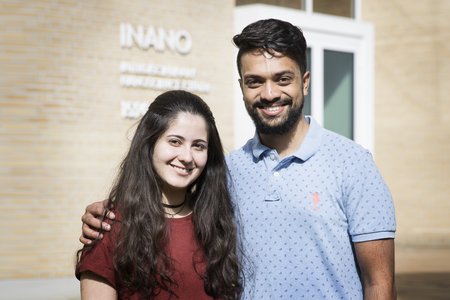
Fabiane Fantinelli Franco, BSc in Physical and Biomolecular Sciences from University of São Paulo, Brazil. Master student at iNANO, Aarhus University.
After finishing my bachelor in Brazil I knew I wanted to study nanotechnology at a prestigious university. The master in nanoscience at Aarhus University offered me what I was looking for: a place that combined both specialised courses in nanotechnology and a good quality of life. It presented the opportunity to take part in a highly qualified education at an internationally recognised institute. Additionally, it is located in one of the best countries in the world - Denmark! The possibility of a scholarship was also a deciding factor that distinguished Aarhus University from other institutions.
I am pleasantly surprised and grateful for my invaluable journey here at iNANO. When I first arrived, I was not expecting to have so many different opportunities outside the scope of the course. One such experience was the Dean's Challenge in semester 1. The case competition called on Science & Technology students to actualise their expertise in developing new ideas to tackle social and environmental challenges. This greatly strengthened my interest in entrepreneurship and innovation. Together with two other students, we used this experience and passion to move a classroom project to a business idea. Our team, Team NanoScreen, has received continuous support from the university. The ability to provide a learning environment both in and outside the classroom and course is, in my experience, unique to Aarhus University and iNANO.
My master thesis experiments were performed at the Hybrid Materials Lab in iNANO and it was a remarkable experience. The laboratories are well equipped and the projects are interconnected, facilitating a supportive culture. I have specialised in inorganic chemistry and materials science, however iNANO has a range of distinctive fields you can specialise in. This interdisciplinarity enhances the quality of the research that is developed at the institute. Doing my master at iNANO has contributed significantly to both my professional and personal development.
I strongly recommend anyone interested in nanotechnology to study at iNANO. It is a new institute equipped with first-rate facilities and excellent professionals, offering a range of courses for students to specialise in their area of interest. Furthermore, Aarhus University is ranked amongst the top universities in the world, constantly providing opportunities for students to further engage in their studies and careers, e.g. conferences, specialised lectures and alumni days. It is a place to enrich your knowledge and career, meet new and inspiring people, and immerse yourself in the Danish culture. Nothing better than the month-long julefrokost and spending some hyggelig time with your friends!
Priyank Shyam, B.Tech. in Nanotechnology from SRM University, India. Master student at iNANO, Aarhus University.
After completing my Bachelor's degree in India, I wanted to pursue an advanced program in nanoscience and simultaneously gain international exposure while doing so. I wanted to pursue a program that would combine intensive classroom-based studies with practical, independent research activities. I found that the Master’s programme in Nanoscience at Aarhus University offered precisely this - here students could directly apply the theoretical concepts learned in the classroom to practical research that solved everyday problems! I also learned that the Interdisciplinary Nanoscience Center (iNANO) at Aarhus University was specifically designed to bring together researchers and students from diverse academic fields to work on exciting research problems. The interdisciplinary research conducted at iNANO has far-reaching implications for various global issues. I did not have to think twice about accepting the opportunity to study and carry out research in such an engaging, interdisciplinary environment!
The two years that I have spent during my Master's studies at Aarhus University have been very enriching and fulfilling!
Out of my many experiences, there are a few which exceptionally stand out: To begin with, the flexibility offered to students in designing their individual customized study program was surprising. In the classroom-based courses, I was astonished by the informal manner in which students and teachers referred to each other on a first-name basis. I saw that this lack of power hierarchy clearly encouraged an academic environment within which students could actively engage with the teacher and vastly improve their understanding of the topic. One of the courses that I took in March 2017 – Science-based Innovation and Entrepreneurship – even encouraged me to embark on an entrepreneurial venture along with a few course mates. Since summer 2017, our venture – NanoScreen – has participated in various Danish and international start-up competitions and also won a few awards in them.
Facing the exams was also a unique challenge. Being accustomed to written examinations throughout my academic life, the Danish system of oral examinations presented an academic ‘cultural shock’. I gradually came to appreciate the strengths of such an examination system, which allows examiners to go beyond the rote learning based paper and gain a better insight into the student's individual understanding of the subject matter. Last, but definitely not the least, the focal point of Danish student life – the “fredagsbars” (Friday bars) deserves special mention. These helped provide a relaxing, social environment to forget the stresses of the academic week and bond with fellow students.
I would definitely recommend pursuing a study program at Aarhus University. As an academic institution, Aarhus University effortlessly balances strong scholastic programs along with hands-on practical experiences. The courses are taught by competent professional experts and are constantly updated to keep up with the most recent advances and trends in their respective fields. The academic environment encourages students to go beyond the classroom and engage in active interdisciplinary collaborations with fellow students and researchers. Events, organised by the various departments, keep one’s social life buzzing and active. Beyond the university, even the city of Aarhus prides itself on being a student city and this is perceptibly felt in various spheres of day-to-day life. I think, that being a part of Aarhus University holistically develops a student’s life - enabling them to pursue fulfilling careers in their chosen fields and contribute to the development of society!

Ram Sarusie, MSc in Nanoscience, working as a material specialist at Færch Plast A/S
For me, Nanoscience at Aarhus University was a great fit, because the interdisciplinary structure of the programme suited me well - I love mathematics and science in general, and not only physics or chemistry. I found it fascinating when the boundaries between physics, chemistry and molecular biology were erased, and it was challenging with teaching across the classic disciplines.
During the programme I had the opportunity to study abroad and chose a one-year exchange at the Hebrew University of Jerusalem in Israel. I can strongly recommend this! The experience abroad challenged me both academically, but just as much personally.
At the end of my programme, I wrote my Master's thesis at the Department of Chemistry in 'hydrogen storage in solid materials'; a sustainable solution for a society without fossil fuels. During this, I acquired in-depth knowledge within chemical syntheses and methods of analysis, as well as knowledge about how to behave in the laboratory, experimental set-ups and firefighting courses.
In my job, I work in our Training and Development department as a material specialist, and my daily tasks are managing exciting projects. The projects range from the development of new and innovative solutions, where I must think outside the box, and to optimisation projects, where current processes or solutions have to be improved.
The job involves being able to explain and understand the phenomena we encounter – requiring that you read up on new and old research, and that you can go back to the fundamental physical and chemical laws, that you learned during your education. I have learned that it is not possible to remember everything from all courses from my Bachelor’s and Master’s programme. However, one of the most important things I have acquired during my education is a solid foundation enabling me to find and understand the relevant information – one of the things that the Nanoscience programme has given me with its broad and interdisciplinary range of natural science.
Nevertheless, since the Nanoscience programme is purely theoretical, except from the laboratory work, I sometimes feel that I lack competencies within the engineering and practical part of my job, but I am sure that there will always be parts of any new job that are new to you. Luckily, I feel that my education at Nanoscience has given me the right prerequisites for learning new skills and competences. These skills also helped me when I won the Dean's Challenge in 2016, which is an innovative case competition for science students at Aarhus University.

The chart shows the five most common types of work for graduates 1-2 years after finishing their degree. The data is derived from a survey made by Epinion for the Ministry of Higher Education and Science and Aarhus University in 2020.
Nanoscience opens doors to roles in research, development and analysis across biotechnology and pharmaceuticals, energy and materials technology, the food and environmental sectors, and sensor technology. Graduates work with research and development of new materials and surfaces, catalysis, nanomedicine and biosensors, quality and process optimisation, data analysis, consultancy and project management. Many pursue careers in large industrial companies, research institutions, start-ups and consultancies.
As a work-integrated master student, you are already employed or running your own venture. The programme can strengthen your role and open new opportunities by enabling you to apply new knowledge directly in practice.
Want to develop your own ideas? The programme’s interdisciplinarity and close link to practice provide a strong springboard for starting a company or driving innovation within your organisation. You can draw on Aarhus University’s entrepreneurship ecosystems, such as The Kitchen.
After graduation, you can apply for a PhD and specialise further in nanoscience. This can lead to careers in academia, in high-tech industry, or in roles at the interface between universities and companies.
