Master's Degree Programme for Working Professionals (4 years)
| About the programme Language: English (See language requirements) | Place of study: Aarhus | Commencement: August / September (See if this programme also offers a January/February start for international applicants). Programme type: Master's Degree Programme for Working Professionals (4 years) |
The work-integrated master in Molecular Biology provides an in-depth understanding of life’s processes at the molecular level. You will acquire advanced knowledge based on the latest research and learn to approach methodological choices, published results, and emerging technologies critically and constructively within key research areas such as biochemistry, cell biology, genetics and bioinformatics.
Throughout the programme, you will study organisms ranging from bacteria and plants to animals and humans. The Department of Molecular Biology and Genetics attracts talented researchers from all over the world, and as the programme is research-based, it is conducted in English.
During the programme, you will learn to design experiments and to collect and analyse molecular biological data, gaining a solid scientific understanding of molecular biological challenges. Typical topics include the study of disease mechanisms and potential therapies, gene structure and regulation, and protein architecture and function.
The Master's degree programme for working professionals is a part-time programme designed for students who are employed while studying, either in a company or as entrepreneurs.
The programme bridges theory and practice by allowing you to connect what you learn directly to relevant work tasks. You contribute the newest academic knowledge to your workplace, while your job gives you practical experience applying your skills.
The programme is designed to be completed in 4 years.
The required level of employment for admission to the professional master’s track is described under 'Admission requirements'.
In this section you can learn more about the admission requirements relevant to the work-integrated master's degree programme in Molecular Biology. Depending on your educational background and your qualifications, there are different ways to meet the admission requirements:
This section is relevant for you, if you have:
The two sections listed below are relevant only for students with a bachelor's degree from a Danish institution:
Below these sections, you can learn more about the employment requirement and the English language requirement. You can also find out which ranking criteria we use to assess your application when prioritizing among the submitted applications.
If you have an international educational background, you must meet both the general admission requirement and the specific admission requirements:
You must have a bachelor's degree or equivalent that is comparable to a Danish bachelor's degree in both level and duration (180 ECTS).
For more information about how your bachelor's degree is assessed, please see the national database.
If you meet the general admission requirement, the university will continue on to assess whether or not you meet the specific admission requirements.
You can be admitted to the master's programme if the university assesses that your education has a level, scope, and content that corresponds to the academic requirements specified below.
| Subject area | Number of ECTS |
| Subject components within molecular biology, biochemistry, genetics, microbiology and bioinformatics /programming including at least 10 ECTS practial laboratory work within molecular biology or molecular medicine | 80 |
| Basic subject components in Mathematics, Probability Calculus, Statistics and Chemistry | 30 |
| Total | 110 |
We cannot assess in advance whether your specific degree will meet the above requirements. Therefore, we recommend that you apply for the programme if you believe that you meet the academic requirements. In this regard, it is a good idea to compare your degree with the programmes that provide direct admission.
No Bachelor's degree programme(s) from Aarhus University entitles applicants to an offer of admission to this work-integrated Master's degree programme.
Certain Bachelor's degree programmes from Aarhus University and various other Danish Universities have been determined to meet the admission requirements to this work-integrated Master's degree programme in Molecular Biology:
If you hold a Bachelor’s degree from a non-Danish university, you must complete the appendix below and upload it to the application portal. The appendix helps the academic assessors with the assessment of your application.
Download appendix
When applying for a work-integrated Master’s degree programme, you must meet the requirement of being in relevant employment.
“Relevant employment” means that you work at least 25 hours per week in a public or private company, or as an entrepreneur, and that your work tasks are professionally related to both your qualifying education and the education you are applying for.
In order to be admitted to this programme you must meet the university's English language requirements.
Students with bachelor's degree from Aarhus University with a so-called 'Legal right of admission' are exempt from the English language requirement.
All Master’s degree programmes at Aarhus University have limited intake. This means that you are not guaranteed admission even if you meet the entry requirements. When we prioritize among applicants, we assess your application based on a set of fixed ranking criteria, which you can see below.
If you have a legal right of admission, you are guaranteed a place in the programme and do not need to consider the ranking criteria.
Ranking criteria:
In criterion three, the score is based on the proportion of subjects on the bachelor’s degree diploma that fall within the relevant subject fields. In this assessment, ECTS credits that are a part of the admission requirements described under ‘Other qualifying degrees’ are not included.
Please note that grades achieved after the application deadline are not included in the assessment.
Unfortunately, Aarhus University is not able to assess your qualifications beforehand. In order for your qualifications to be assessed you must apply for admission. To learn more, please go to Assessment of your qualifications.
During your studies, you will have the opportunity to specialise according to your academic interests. Specialisation takes place through a combination of coursework and participation in research projects within your chosen field. In addition to your specialisation, you can take individual courses in related scientific disciplines such as biology or chemistry.
The programme offers the following core specialisation tracks:
In the second half of the programme, you will complete an independent master’s thesis project under the supervision of an experienced researcher. This is typically carried out in a research group at the Department of Molecular Biology and Genetics, but it may also take place at another relevant institute, provided that an internal supervisor from the Department of Molecular Biology and Genetics is affiliated. You will gain experience with project planning, experimental design, and data analysis, as well as valuable insight into how molecular biological research is conducted. You will also have the opportunity to participate in your supervisor’s research activities, academic discussions, and publications.
The academic regulations provide detailed information about the content of each course. You can also find an overview of the structure of the degree programme and the requirements you must meet as a student – including examination types and assessment criteria.
The work-integrated master in Molecular Biology involves intensive work ranging from lectures and reading to presentations, discussions of scientific papers, and independent research projects under supervision within an active research environment. You will become part of a vibrant study community and can participate in both academic and social events with your fellow students.
Your daily academic life will take place at the Department of Molecular Biology and Genetics, where an entire floor — Mol-X — is dedicated to students.
The Molecular Biology Student Association (Molekylærbiologisk Cellskab) organises everything from parties and Christmas bingo to career-related events focusing on job opportunities after graduation. The association also serves as a hub for student representation within the department.
The Friday Bar, CRISBaR, is open most Fridays during the semester, providing a relaxed social space to round off the week with fellow students. Members of the student association can also help organise and host these events.
Students can engage in the academic community in many ways beyond coursework. The department hosts various events such as Project Day, where you can meet researchers and learn about their projects, and career events where alumni share insights about their transition to the job market and career paths.
Students are also welcome to attend voluntary lectures where the latest research results are presented. Although these are primarily aimed at researchers, they offer a unique opportunity to gain insight into cutting-edge research and to meet leading scientists and industry professionals.
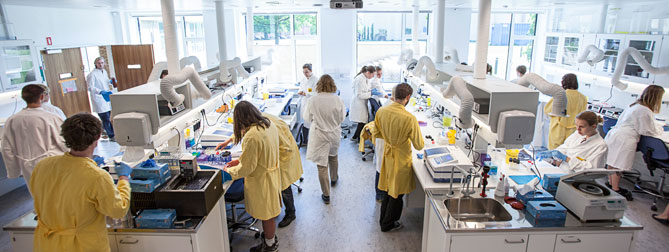
The close integration of research and teaching at the department - with research laboratories, teaching labs, and classrooms located in the same building complex - fosters an open and interactive academic environment. You will regularly meet your lecturers and researchers in shared spaces, providing plenty of opportunities to discuss ideas and ask questions.
-experienced, photographed and filmed by the students themselves.
With thousands of pictures #AUInternational, #AarhusUni gives insight into the everyday life as a student at AU; the parties, procrastination, exams and all the other ways you’ll spend your time at university.
The photos belong to the users, shared with #AUInternational and #AarhusUni.
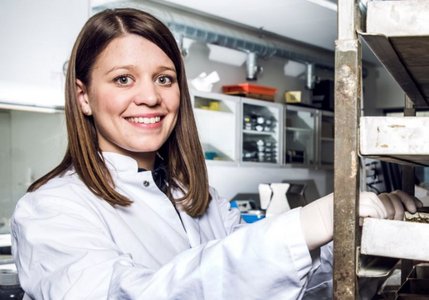
Anne Yde, MSc. in Molecular Biology, PBU Manager at Eurofins Agro Testing
During my Master's programme, I had the freedom to specialise within the topics, I found most interesting. This freedom to choose specific courses was a result of my course combination in my Bachelor’s programme, which meant I only had to follow elective courses during my Master’s programme. For me, this was an advantage and meant that I chose to continue with courses within cell biology primarily.
I spent the final year of my Master's programme working on my thesis in the research laboratory at the Department of Molecular Biology, where I had also worked on my Bachelor's project. For my thesis, I worked on a project where we studied the repair mechanisms of DNA damage in neurons.
In the laboratory, I had the opportunity to learn about life as a researcher and to test methods, which could be of use later in my career. I found it very valuable to get to spend an entire year in the laboratory.
Today I work as a PBU Manager in Eurofins Agro Testing. We are a part of the Eurofins group, an international laboratory group with laboratories around the world. Eurofins in Denmark has more than 700 employees and carry out laboratory analyses within food, environment, agriculture, pharma, products, and materials. At Eurofins Agro Testing, we analyse samples from agriculture, horticulture and forestry, for example feed, soil, manure, and plants.
As PBU Manager, I am responsible for the production in our department. My job is quite varied, and includes both customer support as well as handling and validating results. I am also responsible for a number of methods and therefore handle any deviations in these methods and the development of new initiatives. In addition, I work with some IT tasks concerning the handling of samples, analyses, and results.
We handle many samples in the laboratory each day and you have to work at a high pace. This was a big change from life at the university. On a daily basis I do not use methods which I know directly from my work at the university, but my education as a molecular biologist has given me the ability to familiarise myself with new subject areas as well as a fundamental scientific and analytical approach, which I could not do without in my daily work.
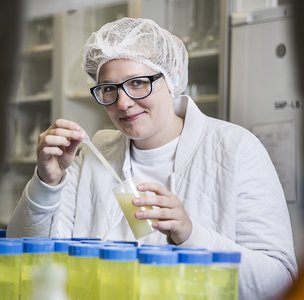
Maiken Østervemb Krogshede, MSc in Molecular Biology, Site Quality Coordinator at Arla Foods Ingredients
My Master’s programme in Molecular Biology was very diverse, allowing students to customize their own academic profile. This meant that I could concentrate more on certain topics and choose elective courses, which matched my interests. I have always thought that health and nutrition were interesting – both functionally and physiologically. It comes naturally to me to ask the question "Why is it like that?", and often molecular biology can help me to find the answers.
The transfer from the study environment to "the real world" has changed my perspective on molecular biology and has given it an extra dimension. I clearly remember visiting the production area on my job for the first time and how fascinating it was to see the use of general molecular principles – and it still fascinates me!
In my daily work, I am a link to the company’s production, laboratory, logistics, sales and development. For each part, I use various skills that I have acquired during my education. For example, I use my knowledge of protein properties when working with the production, while I in the laboratory I use my knowledge about analyses and interpretation of analysis results. Other times it is the ability to communicate information and to acquire new knowledge quickly, which are important.
With my professional knowledge and skills acquired from my study and my daily job, I work on ensuring the high and right quality of whey proteins. By doing so, I am making a difference for many people with special nutritional needs by making use of all the magnificent qualities that whey has. This is in both products with proper nutrition for newborns; products of easily absorbable proteins for patients, elderly people, and athletes; and products with reduced milk proteins for lactose intolerant people.

The chart shows the five most common types of work for graduates 1-2 years after finishing their degree. The data is derived from a survey made by Epinion for the Ministry of Higher Education and Science and Aarhus University in 2020.
With your acquired understanding of life based on the properties and interactions of biological molecules, and your expertise in manipulating and analysing molecules and cells, you will be qualified for a wide range of jobs in the biotechnology, food, and pharmaceutical industries, as well as in universities and the healthcare sector.
The combination of field-specific and general academic competences opens career paths across many sectors and allows collaboration with professionals from diverse backgrounds.
Many graduates from Molecular Biology work in research at universities, university hospitals, or in private industry. At university hospitals, graduates may work with data analysis and genetic counselling, while those in private life science companies often work in development, production, or quality control. Others pursue teaching, communication, or consultancy roles, for example in patenting. Some succeed in business development and entrepreneurship based on molecular biological discoveries or innovations.
The Master's degree programme for working professionals in Molecular Biology thus offers excellent opportunities for an exciting career where you can contribute to human welfare, the green transition, and environmental improvement through research in disease mechanisms and sustainable solutions. Examples of molecular biology applications include drug delivery to specific organs, mapping genetic disorders, enzyme-based plastic degradation, and the conversion of atmospheric nitrogen into plant fertiliser.
