Master's Degree Programme for Working Professionals (4 years)
| About the programme Language: English (See language requirements) | Place of study: Aarhus | Commencement: August / September (See if this programme also offers a January/February start for international applicants). Programme type: Master's Degree Programme for Working Professionals (4 years) |
The Master of Science in Civil and Architectural Engineering at Aarhus University is offered both as a traditional full-time programme and as a four-year work-integrated Master’s degree, where you study while gaining professional experience in a relevant job.
In this model, the programme takes four years to complete, as you work 25 hours per week on average a year alongside your studies. This is a truly unique opportunity in an international context, since only few universities worldwide allow you to integrate paid employment with a full master’s degree.
Instead of applying for a student grant, you receive a salary typically based on the recommended entry-level rates for engineers in Denmark.
This will give you both financial independence and valuable industry experience, while enabling you to apply your academic knowledge directly in the workplace.
Despite the extended duration, you graduate with the exact same degree and academic level (cand.polyt.) as students enrolled in the ordinary full-time Master’s programme.
Aarhus University offers a dedicated matchmaking service that helps connect students with companies. This ensures that you can find a workplace that aligns with your academic interests and career goals, and that your employment tasks are relevant to your studies. You will be assigned an academic supervisor who will support you in planning your study programme and serve as a sparring partner throughout your studies.
The construction sector in Denmark is undergoing rapid and far-reaching change. With strong political and industrial focus on sustainability, climate resilience and digitalisation, the green transition is driving innovation across every part of the built environment.
As a student on the MSc in Civil and Architectural Engineering, you will be part of this transition. You’ll gain the knowledge and tools to contribute to the development of smarter, more sustainable construction, and you’ll learn how to navigate the complex demands facing engineers in a sector where the need for innovation has never been greater.
The programme bridges advanced research with real-world application. You’ll work with the analysis, design and optimisation of buildings and infrastructure – combining classical engineering with digital technologies such as programming, simulation, modelling and machine learning. Throughout the programme, you will be trained to think critically, work across disciplines, and approach engineering challenges with creativity and curiosity.
You’ll build on the foundation from your bachelor’s degree and develop specialist knowledge in areas like structural behaviour, building performance, materials, energy, and urban infrastructure.
The teaching is research-based and project-driven, and you’ll collaborate closely with fellow students, researchers, industry, and the company you work for. You have a great deal of freedom to put together your programme according to your interests. You’ll apply theory to practice through real-world cases and learn how to lead development processes that support the long-term transformation of the construction industry.
When you begin the programme, you will choose one of five specialisation tracks. Each track allows you to shape your academic journey around your own interests and future career, whether you want to work with large-scale infrastructure, innovative materials, smart buildings or the management and transformation of the construction industry.
In this section you can learn more about the admission requirements relevant to the flexible work-integrated Master's degree programme in Civil and Architectural Engineering. Depending on your educational background and your qualifications, there are different ways to meet the admission requirements:
This section is relevant for you, if you have:
The two sections listed below are relevant only for students with a bachelor's degree from a Danish institution:
Below these sections, you can learn more about the employment requirement and the English language requirement. You can also find out which ranking criteria we use to assess your application when prioritizing among the submitted applications.
If you have an international educational background, you must meet both the general admission requirement and the specific admission requirements:
You must have a bachelor's degree or equivalent that is comparable to a Danish bachelor's degree in both level and duration (180 ECTS).
For more information about how your bachelor's degree is assessed, please see the national database.
If you meet the general admission requirement, the university will continue on to assess whether or not you meet the specific admission requirements.
You can be admitted to the master's programme if the university assesses that your education has a level, scope, and content that corresponds to the academic requirements specified below.
| You can meet the admission requirement with Bachelor’s degree programme (BSc) or professional Bachelor's degree programme (BEng) if you have the following subject areas: | Number of ECTS |
Specialization in either:
| 60 |
Mathematics In the following subject areas:
| 20 |
| Total | 80 |
We cannot assess in advance whether your specific degree will meet the above requirements. Therefore, we recommend that you apply for the programme if you believe that you meet the academic requirements. In this regard, it is a good idea to compare your degree with the programmes that provide direct admission.
No Bachelor's degree programme(s) from Aarhus University entitles applicants to an offer of admission to the flexible work-integrated Master's degree programme in Civil and Architectural Engineering.
Certain Bachelor's degree programmes from Aarhus University and various other Danish Universities have been determined to meet the admission requirements to this Master's degree programme:
If you hold a Bachelor’s degree from a non-Danish university, you must complete the appendix below and upload it to the application portal. The appendix helps the academic assessors with the assessment of your application.
Download appendix
When applying for a work-integrated Master’s degree programme, you must meet the requirement of being in relevant employment.
“Relevant employment” means that you work at least 25 hours per week in a public or private company, or as an entrepreneur, and that your work tasks are professionally related to both your qualifying education and the education you are applying for.
In order to be admitted to this programme you must meet the university's English language requirements.
Students with bachelor's degree from Aarhus University with a so-called 'Legal right of admission' are exempt from the English language requirement.
All Master’s degree programmes at Aarhus University have limited intake. This means that you are not guaranteed admission even if you meet the entry requirements. When we prioritize among applicants, we assess your application based on a set of fixed ranking criteria, which you can see below.
If you have a legal right of admission, you are guaranteed a place in the programme and do not need to consider the ranking criteria.
Ranking criteria:
Please note that grades achieved after the application deadline are not included in the assessment.
Unfortunately, Aarhus University is not able to assess your qualifications beforehand. In order for your qualifications to be assessed you must apply for admission. To learn more, please go to Assessment of your qualifications.
At the start of the study, you choose between five study lines:
If you choose the 4 year flexible work-integrated Master’s degree in Civil and Architectural Engineering, your student life will extend over four years. Throughout the entire programme, you combine part-time studies with part-time work in a company or as an entrepreneur, typically 25 hours per week. This means that instead of separating theory and practice, you continuously bring academic knowledge into your workplace while also drawing on real-life challenges in your studies.
Alongside your professional life, you remain an active part of the student community. Your courses are structured with flexibility in mind. This way, you gain colleagues and a professional network, while still experiencing the social life at university.
The Danish academic culture is informal, and you will experience an open, respectful and down-to-earth atmosphere where dialogue and curiosity are encouraged. Professors and researchers always keep their doors open for a conversation – whether you have a question about a lecture, want feedback on a project idea, or simply wish to discuss new developments in the field. Teamwork is a cornerstone in our teaching, and you will work closely with fellow students from different cultural and academic backgrounds, learning to approach problems from multiple perspectives and to develop solutions together.
Your daily life on campus will combine lectures, lab work, and project-based learning. You will take a scientific and experimental approach, working hands-on with prototypes, testing ideas, and developing solutions in practice. Much of the teaching is research-based, and you will be taught by researchers who bring the newest knowledge into the classroom. You will also have the opportunity to participate in research projects yourself. The programme offers a high degree of flexibility, allowing you to shape your own academic journey.
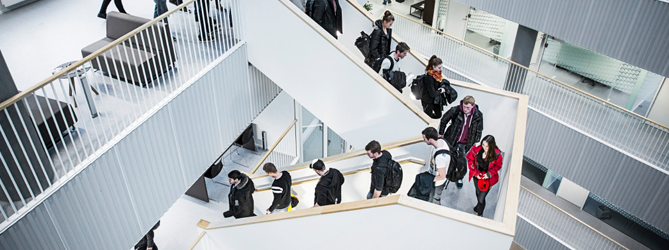
Your campus life unfolds at Navitas – a modern campus building in the heart of Aarhus and only minutes from the University Park. Here, you’ll find light-filled study spaces, advanced laboratories and a vibrant atmosphere.
With an MSc in Civil and Architectural Engineering from Aarhus University, you will be well-prepared to take on a wide range of roles in the construction industry – in Denmark or internationally. You will gain a solid technical foundation, specialist knowledge in your chosen field, and the ability to navigate the growing complexity of sustainable, data-driven and performance-focused construction.
Denmark is known for its ambitious climate goals, progressive building regulations, and strong tradition of collaboration between universities, industry and government. As a graduate from Aarhus University, you will be part of this forward-looking ecosystem – and highly qualified to work in the global transition toward more sustainable construction.
If you choose the flexible work-integrated Master’s degree, your employment during the programme often leads directly to a full-time position in the same company once you graduate. This gives you a unique opportunity to build a career while you study, establish strong professional networks, and step seamlessly into the job market.
Graduates typically find employment in:
Thanks to your strong analytical skills and systems thinking, you will be equipped to lead interdisciplinary projects and take responsibility for both technical and strategic aspects of construction.
We want to help our students find successful careers. Students can always contact our Career Services for advice and assistance with getting onto the Danish labour market. Check out our careers page to see the range of services we offer.
The programme also gives you a strong foundation if you want to continue into research. By pursuing a PhD, you can dive deeper into your field and contribute to pioneering developments in areas such as energy systems, robotics, medical technology, or communication networks.
You can read more about the PhD programme at the Graduate School of Technical Sciences.

![[Translate to English:] Picture of Sumeet Karra](https://ingenioer.au.dk/fileadmin/_processed_/c/b/csm_24_10_25_Sumeet_AL_WEB-5_d6f5fed859.jpg "[Translate to English:] Meet Sumeet Karra from India")