
Full-time Master's Degree Programme (1 year)
| About the programme Language: English (See language requirements) | Place of study: Aarhus | Commencement: August / September (See if this programme also offers a January/February start for international applicants) | Find current tuition fee rate | Programme type: Full-time Master's Degree Programme (1 year) |
Would you like to learn how to turn data into knowledge that can provide the basis for analysis and decision-making? On the one-year Master's degree programme in Applied Data Analytics, you will gain the skills to work with the entire data analysis process – from experimental design, data collection and analysis to communicating results.
The programme is a focused, research-based one-year programme leading to a full Master's degree. You will work with subjects such as programming, mathematics, statistics, machine learning and data visualisation, and complete the programme with a final project on a topic of your choice.
In this section you can learn more about the admission requirements relevant to the Master's degree programme in Applied Data Analytics. Depending on your educational background and your qualifications, there are different ways to meet the admission requirements:
This section is relevant for you, if you have:
The two sections listed below are relevant only for students with a Bachelor's degree from a Danish institution:
Below these sections, you can learn more about the English language requirement. You can also find out which ranking criteria we use to assess your application when prioritizing among the submitted applications.
If you have an international educational background, you must meet both the general admission requirement and the specific admission requirements:
You must have a Bachelor's degree or equivalent that is comparable to a Danish Bachelor's degree in both level and duration (180 ECTS).
For more information about how your bachelor's degree is assessed, please see the national database.
If you meet the general admission requirement, the university will continue on to assess whether or not you meet the specific admission requirements.
You can be admitted to the Master's programme if the university assesses that your education has a level, scope, and content that corresponds to the academic requirements specified below.
| Subject area | Number of ECTS |
Natural sciences The following subject areas must be covered:
| 90 |
There is no Bachelor's degree programme(s) from Aarhus University that provides a legal right of admission to this Master's degree programme.
Certain Bachelor's degree programmes from Aarhus University and various other Danish universities have been determined to meet the admission requirements to this master's degree programme:
All Master’s degree programmes at Aarhus University have limited intake. This means that you are not guaranteed admission even if you meet the entry requirements. When we prioritize among applicants, we assess your application based on a set of fixed ranking criteria, which you can see below.
If you have a legal right of admission, you are guaranteed a place in the programme and do not need to consider the ranking criteria.
Ranking criteria:
1. Grades from the qualifying degree
2. Grades achieved in relevant subject fields:
3. Relevant subject fields (measured in ECTS). In this assessment, ECTS credits that are a part of the admission requirements described under ‘Other qualifying degrees’ are not included.
In criterion three, the score is based on the proportion of subjects on the bachelor’s degree diploma that fall within the relevant subject fields. In this assessment, ECTS credits that are a part of the admission requirements described under ‘Other qualifying degrees’ are not included.
Please note that grades achieved after the application deadline are not included in the assessment.
In order to be admitted to this programme you must meet the university's english language requirements.
Students with bachelor's degree from Aarhus University with a so-called 'Legal right of admission' are exempt from the English language requirement.
Unfortuntely, Aarhus University is not able to assess your qualifications beforehand. In order for your qualifications to be assessed you must apply for admission. To learn more, please go to Assessment of your qualifications.
The one-year Master's degree programme in Applied Data Analytics is structured as a focused programme, with most courses predetermined. The programme concludes with a 15 ECTS final project.
During the first semester, you will build a strong academic foundation in data analytics. You will work with subjects such as programming, mathematics, statistics, probability theory, machine learning and data visualisation, giving you the skills needed to choose a topic for your final project.
During the second semester, you will choose courses that support your Master's project and allow you to explore your chosen topic in greater depth. The programme concludes with a 15 ECTS final project, in which you apply the knowledge and methods you have acquired throughout the programme.
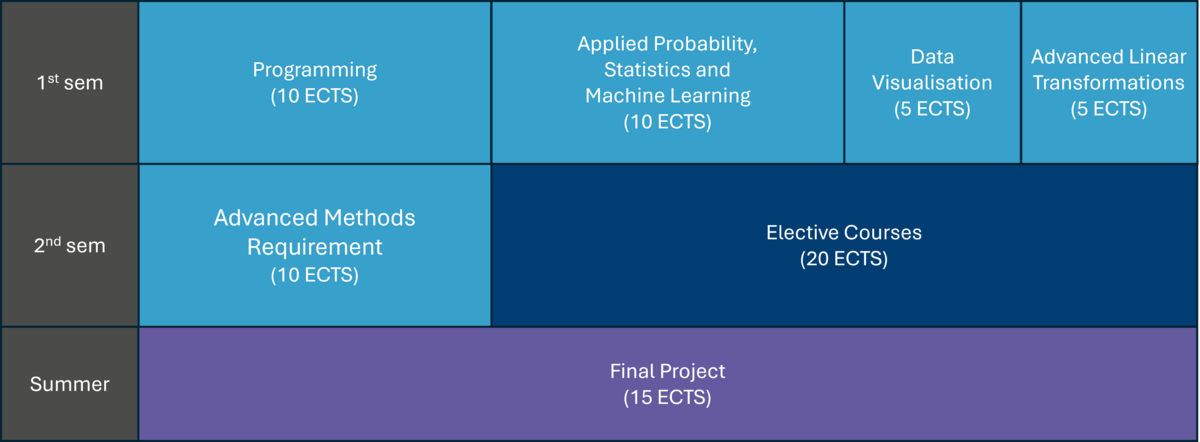
The academic regulations for Applied Data Analytics will be available in late autumn 2026.
The academic regulations contain further information about the content of the individual courses. You can also find information about the structure of the programme and the requirements you must meet as a student, including examination formats and requirements.
The Department of Mathematics offers a wide range of social and academic student associations run by volunteers. These associations organise, among other things, traditional celebrations and events where you can meet fellow students – including students from disciplines other than your own.
You can follow the Department of Mathematics and its students on YouTube and Instagram. Here, you can watch videos, takeovers and posts featuring students and teachers and get a sense of what it is like to be a student here.
You can also follow AU Natural Sciences on Facebook and Instagram and get an insight into student life.
With a Master's degree in Applied Data Analytics, you can work with data analysis across a wide range of industries where there is a need to collect, process and analyse data.
You can, for example, work on analyses that support financial optimisation or identify patterns in complex datasets that can provide a basis for advice and decision-making.
You can find employment in areas such as the financial sector, consultancy firms, public authorities, and research and educational institutions.
